
Industrial AI Safety Supervisor
Intelligent Industrial Monitoring combining IoT sensors, real-time data streaming, Retrieval-Augmented Generation (RAG), and Edge LLMs.
Project Overview
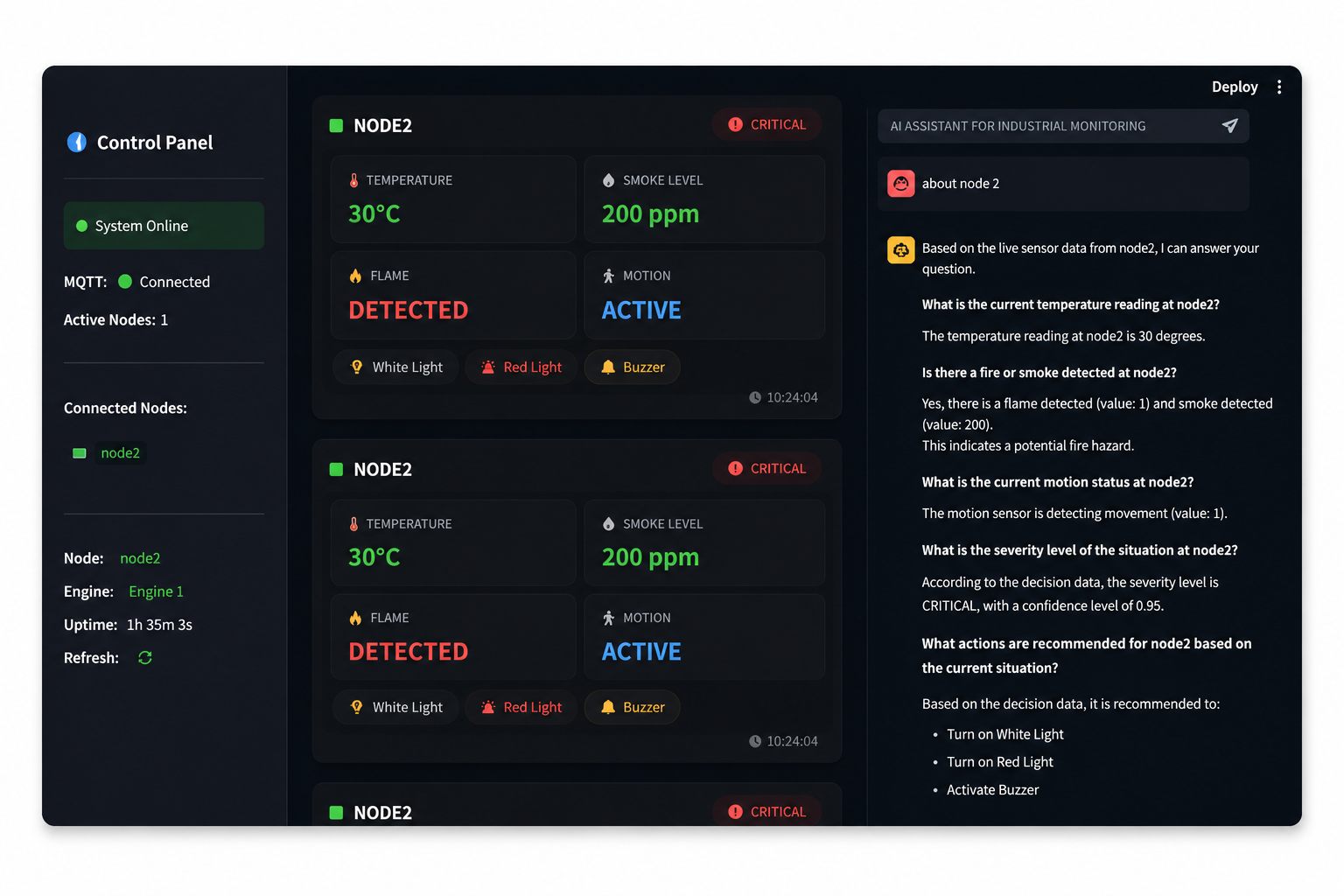
The Industrial AI Safety Supervisor is a next-generation Industrial IoT platform designed to enhance workplace safety, operational efficiency, and intelligent decision-making within modern manufacturing environments. The system combines distributed IoT sensors, real-time data streaming, Retrieval-Augmented Generation (RAG), and locally hosted Large Language Models (LLMs) to continuously monitor factory conditions and provide operators with actionable insights through an interactive AI-powered dashboard.
Unlike traditional monitoring systems that simply display sensor readings, this platform acts as an intelligent industrial supervisor capable of understanding live factory conditions, detecting hazardous situations, recommending corrective actions, and assisting operators through natural language conversations.
The complete platform operates entirely on local infrastructure using Ollama, ensuring low latency, enhanced privacy, and uninterrupted operation without reliance on cloud-based AI services.
Problem Statement
Industrial environments contain numerous sensors that continuously monitor equipment, environmental conditions, and worker safety. Although these sensors generate significant amounts of data, operators often struggle to interpret this information quickly during critical situations.
Traditional SCADA and monitoring systems typically provide numerical values, alarms, and dashboards but lack contextual understanding and intelligent reasoning capabilities. As a result, operators must manually correlate sensor values, identify abnormal conditions, and determine appropriate responses.
Furthermore, many AI-powered monitoring solutions rely on cloud services, introducing concerns regarding latency, privacy, internet dependency, and operational costs. The Industrial AI Safety Supervisor addresses these limitations by integrating IoT sensing, real-time data streaming, local AI inference, and Retrieval-Augmented Generation into a unified platform capable of providing intelligent operational assistance in real time.
Project Objectives
- Develop a real-time industrial monitoring platform capable of collecting sensor data from multiple distributed IoT devices.
- Enable intelligent safety analysis using locally hosted Large Language Models.
- Eliminate AI hallucinations through Retrieval-Augmented Generation (RAG).
- Provide operators with a conversational interface for interacting with industrial systems.
- Automate industrial safety decisions through AI-generated recommendations.
- Design a scalable and containerized architecture suitable for Industry 4.0 deployments.
System Architecture
The system follows a modular microservices architecture that separates sensing, communication, intelligence, storage, and visualization into independent components.
Working Principle & IoT Infrastructure
The system begins with multiple ESP32-based IoT nodes installed throughout an industrial facility. Each node continuously measures environmental parameters such as temperature, smoke concentration, flame detection, and human motion.
The collected sensor values are transmitted to a central MQTT broker using lightweight publish-subscribe communication. The backend server subscribes to these MQTT topics and immediately stores incoming sensor readings into a local SQLite database for historical analysis.
Retrieval-Augmented Generation (RAG)
One of the most significant innovations within this project is the implementation of Retrieval-Augmented Generation.
Large Language Models often generate incorrect responses when asked about information unavailable within their training data. To overcome this challenge, the backend retrieves the latest sensor readings directly from the IoT network before generating the prompt supplied to the language model. This process ensures that every AI response is grounded in real-time industrial conditions.
"Is there any fire risk in Node 03?"
The backend retrieves the latest sensor values such as temperature, smoke concentration, flame detection, and motion status before constructing the AI prompt. Consequently, the language model reasons exclusively from verified sensor data instead of relying on assumptions. This architecture significantly improves response reliability while eliminating hallucinations.
AI Decision Engine
Beyond conversational responses, the platform incorporates an AI decision engine responsible for classifying industrial safety conditions into Normal, Warning, or Critical states. The decision engine also recommends actuator operations including warning lights, alarms, or emergency shutdown procedures.
Tech Stack
Hardware
Software & Backend
Artificial Intelligence
Key Features
- Real-Time Multi-Node Monitoring
- AI-Powered Safety Analysis
- RAG Hallucination Elimination
- Interactive AI Chat Assistant
- Automated Action Commands
- 100% Offline Local Inference
Want to implement this?
Discuss your industrial automation requirements with our expert engineering team.
Get In Touch